Who He is to us, and who we are to Him. “But grow in grace, and in the knowledge of our Lord and Saviour Jesus Christ. To Him be glory both now and for ever. Amen” (2Peter 3:18 KJV). Many years ago, I would have agreed with the word Relationship, but only superficially. I would have actually meant, “Get them saved, ” then repeat the process with the next one. But, they come in through the front door and leave through the back door. We try to solve the problem by social engagement, church member interacting with church member, with the understanding, “They won’t leave, if they have friends.” But, then they leave with their friends. Perhaps we need to be asking one another, “What is the LORD trying to teach us about Himself?” How has our understanding of His Word’s application to ourselves changed our understanding of Him? Paul seems to have captured that understanding. “That I may know Him, and the power of His resurrection, and the fellowship of His sufferings, being made conformable unto His death” (Philippians 3:10). Father, stir us out of our lethargy. Cause us not to be satisfied with the way things are. Enable us to see You as our all in all to meet all the difficulties of life that You use to motivate us. May our cries for help fall upon Your hearing ears. May our hearts not be satisfied with mere answers for our deliverance, but may we see Your glory. In Jesus’ name, we pray. Amen.
Author: Ken
Love or Obey?
“My son, give me thine heart, and let thine eyes observe my ways” (Proverbs 23:26 KJV). God is dealing with His created beings, who have the capacity to choose or reject Him. That has always been the significance of being human. Embryos that grow two heads or children who turn into angry screaming grievance collectors, what’s worse? Jesus reminded us, “Thou shalt love the Lord thy God with all thy heart, and with all thy soul, and with all thy mind,” and “Thou shalt love thy neighbour as thyself” (Matthew 22:37, 39). Both love and obedience are equally important. What is more significant, faith or works? “Yea, a man may say, Thou hast faith, and I have works: shew me thy faith without thy works, and I will shew thee my faith by my works” (James 2:18). Both faith and works are equally important. Let us not turn life or the study of God into impossible choices. Instead, “Trust in the LORD with all thine heart; and lean not unto thine own understanding. In all thy ways acknowledge Him, and He shall direct thy paths” (Proverbs 3:5-6). Father, form us into the image of Christ. Magnify Yourself by how well we reflect You. Lord Jesus, return quickly. In Jesus’ name, we pray. Amen.
Joe Versus the Volcano
Are you awake? “Awake thou that sleepest, and arise from the dead, and Christ shall give thee light” (Ephesians 5:14 KJV). Patricia (Meg Ryan) said to Joe (Tom Hanks) in the fantasy comedy movie, “Joe Versus the Volcano” (1990): “My father says that almost the whole world is asleep. Everybody you know. Everybody you see. Everybody you talk to. He says that only a few people are awake and they live in a state of constant total amazement.” Do you see more than just what the average church member has been programmed to see, as they encourage themselves they are on their way to Heaven? “How narrow is the gate and difficult the way that leads to life, and there are few who find it!” (Matthew 7:14 NET).
Ways of His Words (Psalm 119:3)
“They also do no iniquity: they walk in His ways” (Psalm 119:3 KJV). Negatively, we do no evil. How can we be so sure? Because, positively, we are walking in His ways. This is positive holiness, for we are separated to “walking in His ways.” In our Unity of Moral action, we cannot be both holy and sinful at the same time. If we are truly doing no iniquity, then we are walking in His ways. Our purpose, intention, or emphasis must be Him. Loss of that intention, all is lost. We must persevere “to the end” (Matthew 10:22) with wholehearted devotion to Him. LORD, make it so. In Jesus’ name, amen.
Two Olivet Discourses?
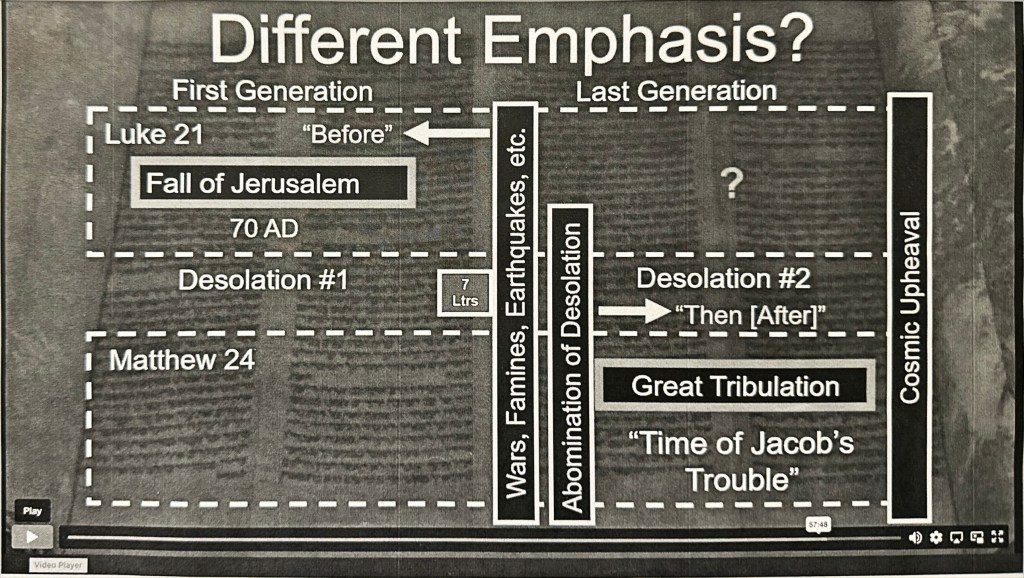
No, but the Holy Spirit communicated different messages (Matthew 24-25; Mark 13; Luke 21) by the emphasis and focus He gave the Gospel writers’ choice of words in their reporting. The difference can be as great as the Preterist insistence that all prophecy was practically fulfilled in the 70 AD Roman destruction of Jerusalem (Luke 21), and the opposing Futurist insistence that the Seventieth Week of Daniel (Daniel 9:24-27) is coming and soon to be fulfilled (Matthew 24).
Matthew’s Gospel was directed more to the Jewish mindset with the identification of Jesus as King, Messiah, and Savior of the Jews. Hence, Matthew points out the Abomination of Desolation (Daniel 9:27 cp. Matthew 24:15) and Luke does not. Written in 63-68 AD, Luke foretells the upcoming 70 AD destruction of Jerusalem, where Jesus warned Christians to flee “when ye shall see Jerusalem compassed with armies” (Luke 21:20 KJV). Christ made possible the escape from the Roman destruction of Jerusalem of all those who believed the Gospel of Luke’s warning. In similar fashion, Christ will make possible the future escape of all those who believe His warning about the prophetic “abomination of desolation” (Matthew 24:15), when it finally occurs.
The crucial flaw of the Preterist position, i.e., essentially all prophecy was fulfilled in the 70 AD destruction of Jerusalem, is the lack of the Abomination of Desolation fulfillment at a time future to Christ’s pronouncement on the Mount of Olives, i.e., “When ye therefore shall see the abomination of desolation” (Matthew 24:15), and certainly not an already occurred fulfillment, i.e., Antiochus Epiphanies (“God Manifest”) sacrificing swine flesh on the Jewish Temple altar between the OT and NT eras. “3 Let no man deceive you by any means: for that day shall not come, except there come a falling away first, and that man of sin [Antichrist] be revealed, the son of perdition; 4 Who opposeth and exalteth himself above all that is called God, or that is worshipped; so that he as God sitteth in the temple of God, shewing himself that he is God” (2Thessalonians 2:3-4).
Luke’s Gospel had more the Gentile readers in view, not mentioning the Abomination of Desolation (Daniel 9:27), yet, both Matthew and Luke mention a crisis with Jerusalem, causing any faithful inhabitants to flee: (1) 70 AD, “when ye shall see Jerusalem compassed with [Roman] armies,” then “flee” (Luke 21:20, 21), and (2) prophetic future, Tribulation Week, Seventieth Week of Daniel, “When ye therefore shall see the abomination of desolation, spoken of by Daniel,” then “flee” (Matthew 24:15, 16). Matthew, Mark, and Luke foresaw “nation shall rise against nation” (Matthew 24:7; Mark 13:8; Luke 21:10). All the Synoptic Gospels recorded the betrayal of friends and family by those who do not share your loyalty to Christ (Matthew 24:10; Mark 13:12; Luke 21:16). If this turmoil took place within Christ’s Twelve Apostles, should we be surprised it would take place prior to Roman’s destruction of Jerusalem in 70 AD, or that it would characterize a future time in the Tribulation Week shortly before the Second Coming of Jesus Christ?
The confusion of Biblical interpreters amounts to whether we take the obvious message of Christ’s Sermon on the Mount (Olivet Discourse) and find fulfillment solely in the 70 AD Roman Destruction of Jerusalem (Luke 21), or whether we can also discern the deeper implication of a future Abomination of Desolation (Matthew 24:15) and the Seventieth Week of Daniel (Daniel 9:24-27).
Failure to see the Futurist View of an upcoming Tribulation Week separates much of the Evangelical Church, where Israel practically has been replaced by the Church, and Israel has no future role in the Kingdom of God, but an asterisk or footnote to the future glory of the Church. Of note, this liberalization of OT prophecy is due to a distaste of taking God’s Word at face value, literally, and in my opinion, contributes to the overpowering antisemitism permeating secular society. The Church cannot restrain secular society from antisemitism because it does not view antisemitism as any worse than any other hatred. To be clear, Antisemitism is the focus of Satan’s hatred upon God’s chosen people. “Come, and let us cut them off from being a nation; that the name of Israel may be no more in remembrance” (Psalm 83:4). Remember, only “through their [Israel’s] fall salvation is come unto the Gentiles” (Romans 11:11), but it is “for to provoke them [Israel] to jealousy” (11:11) that Israel finally would be saved. “For I would not, brethren, that ye should be ignorant of this mystery, lest ye should be wise in your own conceits; that blindness in part is happened to Israel, until the fulness of the Gentiles be come in” (11:25). Luke’s Gospel instructs us, the times of the Gentiles is about to end. “And they shall fall by the edge of the sword, and shall be led away captive into all nations: and Jerusalem shall be trodden down of the Gentiles, until the times of the Gentiles be fulfilled” (Luke 21:24).
LORD, certainly this discussion is like so much noise that must be blocked out because of the more pressing matters of day to day survival. But, Spirit of God, use this understanding to remove the blinders from our eyes, which have held us in our respective theological traditions. May the day come again where there is “One Lord, One Faith, One Baptism” (Ephesians 4:6), but especially, “One God and Father of all, who is above all, and in you all” (4:7). Lord Jesus, return quickly. Amen and amen.
For a more developed discussion, see our article, Do You Believe There Will Be New Heavens and New Earth?
Treasuring His Word (Psalm 119:2)
“Blessed are they that keep [Hebrew, nâtsar, guard, watch, observe] His testimonies, and that seek Him with the whole heart” (Psalm 119:2 KJV). Why are they blessed? For two reasons. They (1) “keep His testimonies,” i.e., because they are important, so they obey them, and (2) “seek Him with the whole heart,” i.e., emphasis is upon the LORD, and absolute giving of the heart to Him. None other than “whole heart” seeking is possible, since “no man can serve two masters” (Matthew 6:24). LORD, deliver us from half hearted seeking, believing we can be blessed by such deceptiveness. Show us Your glory. In Jesus’ name, we pray. Amen.
Vain is the Help of Man
“Some trust in chariots, and some in horses: but we will remember the name of the LORD our God” (Psalm 20:7 KJV). David slew Goliath, not because of superior armament, but because of His trust in the LORD. In life, warfare, politics, business, and sports, we conceive of competition, where my victory is only your defeat. Where I live, because you die. But, we forget, God is more interested in our heart than He is in our financial bottom line or the results of an election. “Keep thy heart with all diligence; for out of it are the issues of life” (Proverbs 4:23). If I must sacrifice my relationship to God, then I would not want that victory. “For what shall it profit a man, if he shall gain the whole world, and lose his own soul?” (Mark 8:36). God’s people become like the world, when they measure victory in terms other than faith. “For whatsoever is born of God overcometh the world: and this is the victory that overcometh the world, even our faith” (1John 5:4). It is more important that God would be honored than I live, succeed, or prosper. Only those who create their god as a figment of their imagination can afford to sacrifice that god for the benefit of their success. Only those who see nothing beyond the here and now could sneer, “Winning Is Everything, Stupid.” Father, deliver us from the victories, where Christ is not enshrined as the Victor. Teach us to compete so no one can take away our crown of victory. Cause us to elevate our understanding of You and our opinions about ourselves that we might war a good warfare. Lord Jesus, return quickly. Amen and amen.
Happiness From His Word (Psalm 119:1)
“ALEPH. Blessed [Hebrew, esher, happiness or blessedness] are the undefiled [Hebrew, tâmîym, whole, sound, healthful] in the way, who walk in the law of the LORD” (Psalm 119:1 KJV). Yes, we are blessed or happy, but why? We are as Noah was a “just [Hebrew, tâmîym, perfect]” (Genesis 6:9 KJV), or undefiled by the physical and spiritual curse of the Nephilim, but why? We are undefiled, because we walk in the law of the LORD. True, we walk not in the “counsel of the ungodly” (Psalm 1:1), but we “delight” and “meditate” in the “law of the LORD” (1:2). If we stop there, we miss the point. It is the LORD’s law. Without Him, we have no source or focus. He alone is able to give meaning to the law. We learn of Him and His character by our association with that law. Unless we view our time around His Word as something more than a word study, then we escape the grand point of our existence — to “know Him” (Phillippians 3:10).
Fighting on Foreign Ground
Home court advantage always belongs to the LORD. Our opponents mistake our strength, as if it depended upon our location. “And the servants of the king of Syria said unto him, Their gods are gods of the hills; therefore they were stronger than we; but let us fight against them in the plain, and surely we shall be stronger than they” (1Kings 20:23 KJV). The LORD always wants His people to prepare their utmost for the battle and the likely casualties of the battle, but to undoubtedly trust Him for the victory. As at another time King Jehoshaphat of Judah prayed about his coming battle, “O our God, wilt thou not judge them? for we have no might against this great company that cometh against us; neither know we what to do: but our eyes are upon Thee” (2Chronicles 20:12). The LORD must take great pleasure in delivering His people to demonstrate He is the LORD, because He also did it for even the Northern Kingdom of Israel: “26 And it came to pass at the return of the year, that Benhadad numbered the Syrians, and went up to Aphek, to fight against Israel. 27 And the children of Israel were numbered, and were all present, and went against them: and the children of Israel pitched before them like two little flocks of kids; but the Syrians filled the country. 28 And there came a man of God, and spake unto the king of Israel, and said, Thus saith the LORD, Because the Syrians have said, The LORD is God of the hills, but he is not God of the valleys, therefore will I deliver all this great multitude into thine hand, and ye shall know that I am the LORD” (1Kings 20:26-28). LORD, may we know the certainty that here or away, You are the God, who delivers us. Teach us to act and believe, “Not by might, nor by power, but by My Spirit, saith the LORD of hosts” (Zechariah 4:6). Come quickly, Lord Jesus, and deliver Your people. In Your name, we pray. Amen.
What is the Doctrine of Christ?
Unity in the Body of Christ is one of the indications to the world of Christ’s reality and divine love for them. “I in them, and Thou in Me, that they may be made perfect in one; and that the world may know that Thou hast sent Me, and hast loved them, as Thou hast loved Me” (John 17:23 KJV). As important as unity is, Christians need to be even more careful about the teachings or “principles of the doctrine of [concerning] Christ” (Hebrews 6:1), because “whosoever transgresseth, and abideth not in the doctrine of [concerning] Christ, hath not God” (2John 1:9). Since “a little leaven leaveneth the whole lump” (1Corinthians 5:5-6; Galatians 5:9), once those in our Christian fellowship adamantly maintain doctrines about Christ contrary to the truth, either they depart from our fellowship or you depart from them. “If there come any unto you, and bring not this doctrine, receive him not into your house, neither bid him God speed: For he that biddeth him God speed is partaker of his evil deeds” (2John 1:10-11).
For instance, if in your attempt for ecumenical unity and cooperation, you found one of the church participants, such as the Roman Catholic Church, teaching Mary as “Co-redemptrix, Mediatrix of all Graces and Advocate,” i.e., “Mary’s singular and unique sharing with her Son in the saving work of Redemption for the human family,” then you must reject your association with that church. “Neither is there salvation in any other: for there is none other name under heaven given among men, whereby we must be saved” (Acts 4:12). The purity of your devotion to Christ requires you to “come out from among them, and be ye separate, saith the Lord, and touch not the unclean thing; and I will receive you” (2Corinthians 6:17). If our actions represent our devotion to Christ, then we are defending Christ, not just words, teachings, or doctrines about Christ. Father, cause our devotion to You to be greater than our attempt to prove the correctness of our doctrine or the incorrectness of anyone else. Preserve Your people in loving obedience and cast out the bondwoman who would draw us back to Babylon. In Jesus’ name, we pray. Amen and amen.
 We Need A Miracle
You must be logged in to post a comment.