Nobody Knows How Long

Why Do We Not Study Prophecy, If It Is So Important? 

How Long? (4:34) is a song expressing what every child vocalizes to their parent about the future, but isn’t that the essence of Bible prophecy? 

Didn’t see it coming, and when the calamity of the invasion of Judah happened, no prophet was at hand giving words of understanding, comfort, and deliverance, at least, as far as this Psalmist could see. “We see not our signs: there is no more any prophet: neither is there among us any that knoweth how long. O God, how long shall the adversary reproach? shall the enemy blaspheme Thy name for ever?” (Psalm 74:9-10 KJV). Of course, we live in different times, but you can see how knowing what has happened, is happening, and is going to happen, practically benefits the people of God. It is intrinsic to human nature to ask, “How long?” Children want to know on a trip, “Are we their yet?” More than a dozen times in the Book of Psalms alone, the Psalmist raises the question, “How long?” In the wisdom of God, He has provided prophecy to answer this question; again, why are we not studying prophecy

But, you say, “Anybody can make a wild prediction about the Terminal Generation, when Jesus is supposed to rapture His Church and come back. What happens, when nothing happens? Doesn’t it do more harm than good for the cause of Christ? Shouldn’t we be more encouraging people how to live for Christ than giving them confusing instructions that might not take place? Wasn’t all prophecy practically fulfilled with the destruction of Jerusalem in 70 AD, anyway? Besides, didn’t Jesus say no one knows when He will return? Shouldn’t we just emphasize there will one day be a New Heaven and New Earth and let it happen whenever it happens, no matter how long it takes?” 

[Scan ahead. This is a longer entry, but not too long.]

First, Predictive Prophecy (prophecies that predict a specific outcome) are found in 8,352 verses of the Bible (27% of Scripture), according to J. Barton Payne’s Encyclopedia of Biblical Prophecy. 256 verses (63%) of the Book of Revelation, written by the Apostle John about 96 AD (long after the fall of Jerusalem in 70 AD), were predictions. “Howbeit when He, the Spirit of truth, is come, He will guide you into all truth: for He shall not speak of Himself; but whatsoever He shall hear, that shall He speak: and He will shew you things to come” (John 16:13). 

Second, God is indisputably the source of all true prophecy. “Remember the former things of old: for I am God, and there is none else; I am God, and there is none like Me, Declaring the end from the beginning, and from ancient times the things that are not yet done, saying, My counsel shall stand, and I will do all My pleasure” (Isaiah 46:9-10). Prophecy proves the veracity of God and His Scripture. “For the prophecy came not in old time by the will of man: but holy men of God spake as they were moved by the Holy Ghost” (2Peter 1:21).

Third, prophecy, like all the other Scripture, testifies of Christ. “Search the scriptures; for in them ye think ye have eternal life: and they are they which testify of Me” (John 5:39). The purpose of prophecy is to bear testimony to Jesus, which then is the “revelation of Jesus Christ” (Revelation 1:1), so then the “testimony of Jesus is the spirit of prophecy” (19:10).

Fourth, prophecy must have a purifying effect upon the Church of Christ, or it is being studied for the wrong reasons. “Not forsaking the assembling of ourselves together, as the manner of some is; but exhorting one another: and so much the more, as ye see the day approaching” (Hebrews 10:25). 

Fifth, prophecy must be proven to each disciple by the Holy Spirit from personal examination of the Word of God. “Prove all things; hold fast that which is good” (1Thessalonians 5:21). Never take anyone’s word about Scripture without proving it to your own satisfaction. “These were more noble than those in Thessalonica, in that they received the word with all readiness of mind, and searched the scriptures daily, whether those things were so” (Acts 17:11). 

Sixth, if the Devil knows Jehovah’s predictions for the future, won’t he oppose God’s plans and work to keep us ignorant of what God is trying to accomplish in human history? Yes, our adversary does not want us to know God’s prophecies, because he doesn’t want us opposing his diabolical plans. If Satan knows the physical seed of Eve would produce Christ, then he will oppose the physical lineage that produced Jesus Christ, and will work to establish his own physical seed, potentially in the Antichrist. A prophecy concerning Christ and the Antichrist: “And I will put enmity between thee and the woman, and between thy seed and her seed; it shall bruise thy head, and thou shalt bruise his heel” (Genesis 3:15). The devil would not have crucified Jesus, if he understood God’s plan. “Which none of the princes of this world knew: for had they known it, they would not have crucified the Lord of glory” (1Corinthians 2:8). 

For example, how would the Wise Men of the Christmas Story even know of a Promised Messiah, if Daniel, the chief of “all the wise men of Babylon” had not told them (Daniel 2:48; 5:11)? And, how could Daniel know about the physical birth of a Messiah had not Micah earlier predicted it (Micah 5:2)? And, why would Micah be prophesying of the physical birth of a coming deliverer, if he did not think there was truth to Yahweh’s pronouncement of a future physical seed and lineage from Eve (Genesis 3:15; Psalm 132:11)? Why were Simeon and Anna even looking for the birth of a Hebrew male child unless they believed the Predictive Prophecy of Daniel (Luke 2:25-38)? And, if it took the understanding of Predictive Prophecy to appreciate, cooperate, and coordinate with the Messiah’s First Advent for the purpose of our salvation (“but not for Himself” Daniel 9:25-26), how can we not study prophecy to pray (Ezekiel 36:37), prepare, cooperate, and coordinate (Matthew 6:10) with Yahweh for the Second Advent of the Conquering Messiah to set up His earthly Millennial Kingdom (Daniel 7:14)?

Seventh, no one is allowed to set dates, when Christ is supposed to return, i.e., “It is not for you to know the times or the seasons, which the Father hath put in His own power” (Acts 1:7). Even if we think we know anything about the time of the return of the Lord Jesus Christ, we cannot absolutely know it, for even the Son has divinely covenanted with the Father not to know. “But of that day and that hour knoweth no man, no, not the angels which are in heaven, neither the Son, but the Father” (Mark 13:32). 

Eighth, it is fruitless not to study prophecy because misunderstandings, contentions, false prophets, and the False Prophet will come anyway. “It is impossible but that offences will come: but woe unto him, through whom they come” (Luke 17:1). 

Ninth, without a proper understanding of prophecy, the Church will not have a clear understanding of how to set the battle in array for the End Times. Who is on the LORD’s side, and who is the enemy? “He that is not with Me is against Me; and he that gathereth not with Me scattereth abroad” (Matthew 12:30).

Tenth, without the ability to distinguish between ‘taking God at His word’ as opposed to ‘taking God literally, as opposed to figuratively,’ the Church will build prejudices and obstacles to understanding Prophetic Predictions. “God is not a man, that He should lie; neither the son of man, that He should repent: hath He said, and shall He not do it? or hath He spoken, and shall He not make it good?” (Numbers 23:19).

Eleventh, but still, without the ability to appreciate figurative or poetic language, the Church will lose the ability to make Spirit-filled applications of God’s Prophecies, which results in legalism and loveless service of God. “Nevertheless I have somewhat against thee, because thou hast left thy first love” (Revelation 2:4). 

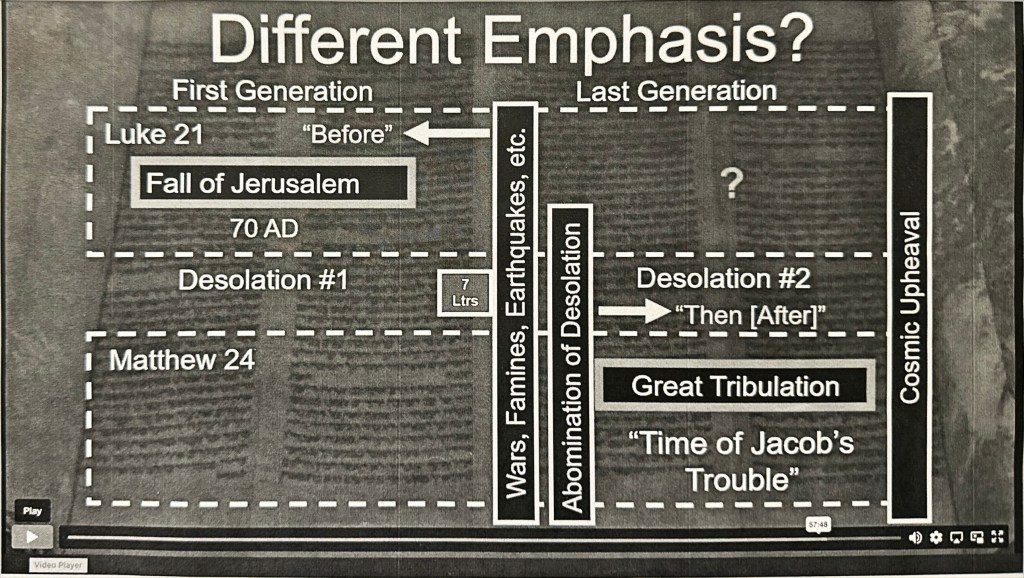
Twelfth, but doesn’t Jesus’ Olivet Discourse plainly indicate Christ’s prophecies were referring to the upcoming destruction of Jerusalem in 70 AD by the Romans, i.e., “when ye shall see Jerusalem compassed with armies” (Luke 21:20), thus bringing to a practical conclusion all the prophecies? True, Luke’s account of the Sermon on the Mount may lend itself to that interpretation, but Matthew’s account of the Sermon on the Mount gives us the additional understanding “when ye therefore shall see the abomination of desolation, spoken of by Daniel the prophet, stand in the holy place” (Matthew 24:15), indicating a double fulfillment and future time, yet to come. 

Father, You are the God of all prophecy, and You know we want to know how long, so we can cooperate with the return of Your Son. May our prayer, Thy kingdom come, be accompanied by our heartfelt, Thy will be done, that there would be great gain for Your kingdom. Help us to block off all means of the enemy taking advantage of us and using us against You. We need Your Spirit’s intervention. Through You, we shall do valiantly! Lord Jesus, return quickly. Amen and amen. 

For a more developed discussion of Christ’s Olivet Discourse, the difference between the Preterist view that prophecy was fulfilled essentially by the Roman destruction of Jerusalem in 70 AD and the Futurist view of a yet to be prophetic fulfillment of the Seventieth Week of Daniel, see our article, Two Olivet Discourses?
Two Olivet Discourses?

No, but the Holy Spirit communicated different messages (Matthew 24-25; Mark 13; Luke 21) by the emphasis and focus He gave the Gospel writers’ choice of words in their reporting. The difference can be as great as the Preterist insistence that all prophecy was practically fulfilled in the 70 AD Roman destruction of Jerusalem (Luke 21), and the opposing Futurist insistence that the Seventieth Week of Daniel (Daniel 9:24-27) is coming and soon to be fulfilled (Matthew 24). 

Matthew’s Gospel was directed more to the Jewish mindset with the identification of Jesus as King, Messiah, and Savior of the Jews. Hence, Matthew points out the Abomination of Desolation (Daniel 9:27 cp. Matthew 24:15) and Luke does not. Written in 63-68 AD, Luke foretells the upcoming 70 AD destruction of Jerusalem, where Jesus warned Christians to flee “when ye shall see Jerusalem compassed with armies” (Luke 21:20 KJV). Christ made possible the escape from the Roman destruction of Jerusalem of all those who believed the Gospel of Luke’s warning. In similar fashion, Christ will make possible the future escape of all those who believe His warning about the prophetic “abomination of desolation” (Matthew 24:15), when it finally occurs. 

The crucial flaw of the Preterist position, i.e., essentially all prophecy was fulfilled in the 70 AD destruction of Jerusalem, is the lack of the Abomination of Desolation fulfillment at a time future to Christ’s pronouncement on the Mount of Olives, i.e., “When ye therefore shall see the abomination of desolation” (Matthew 24:15), and certainly not an already occurred fulfillment, i.e., Antiochus Epiphanies (“God Manifest”) sacrificing swine flesh on the Jewish Temple altar between the OT and NT eras. “3 Let no man deceive you by any means: for that day shall not come, except there come a falling away first, and that man of sin [Antichrist] be revealed, the son of perdition; 4 Who opposeth and exalteth himself above all that is called God, or that is worshipped; so that he as God sitteth in the temple of God, shewing himself that he is God” (2Thessalonians 2:3-4). 

Luke’s Gospel had more the Gentile readers in view, not mentioning the Abomination of Desolation (Daniel 9:27), yet, both Matthew and Luke mention a crisis with Jerusalem, causing any faithful inhabitants to flee: (1) 70 AD, “when ye shall see Jerusalem compassed with [Roman] armies,” then “flee” (Luke 21:20, 21), and (2) prophetic future, Tribulation Week, Seventieth Week of Daniel, “When ye therefore shall see the abomination of desolation, spoken of by Daniel,” then “flee” (Matthew 24:15, 16). Matthew, Mark, and Luke foresaw “nation shall rise against nation” (Matthew 24:7; Mark 13:8; Luke 21:10). All the Synoptic Gospels recorded the betrayal of friends and family by those who do not share your loyalty to Christ (Matthew 24:10; Mark 13:12; Luke 21:16). If this turmoil took place within Christ’s Twelve Apostles, should we be surprised it would take place prior to Roman’s destruction of Jerusalem in 70 AD, or that it would characterize a future time in the Tribulation Week shortly before the Second Coming of Jesus Christ? 

The confusion of Biblical interpreters amounts to whether we take the obvious message of Christ’s Sermon on the Mount (Olivet Discourse) and find fulfillment solely in the 70 AD Roman Destruction of Jerusalem (Luke 21), or whether we can also discern the deeper implication of a future Abomination of Desolation (Matthew 24:15) and the Seventieth Week of Daniel (Daniel 9:24-27). 

Failure to see the Futurist View of an upcoming Tribulation Week separates much of the Evangelical Church, where Israel practically has been replaced by the Church, and Israel has no future role in the Kingdom of God, but an asterisk or footnote to the future glory of the Church. Of note, this liberalization of OT prophecy is due to a distaste of taking God’s Word at face value, literally, and in my opinion, contributes to the overpowering antisemitism permeating secular society. The Church cannot restrain secular society from antisemitism because it does not view antisemitism as any worse than any other hatred. To be clear, Antisemitism is the focus of Satan’s hatred upon God’s chosen people. “Come, and let us cut them off from being a nation; that the name of Israel may be no more in remembrance” (Psalm 83:4). Remember, only “through their [Israel’s] fall salvation is come unto the Gentiles” (Romans 11:11), but it is “for to provoke them [Israel] to jealousy” (11:11) that Israel finally would be saved. “For I would not, brethren, that ye should be ignorant of this mystery, lest ye should be wise in your own conceits; that blindness in part is happened to Israel, until the fulness of the Gentiles be come in” (11:25). Luke’s Gospel instructs us, the times of the Gentiles is about to end. “And they shall fall by the edge of the sword, and shall be led away captive into all nations: and Jerusalem shall be trodden down of the Gentiles, until the times of the Gentiles be fulfilled” (Luke 21:24).

LORD, certainly this discussion is like so much noise that must be blocked out because of the more pressing matters of day to day survival. But, Spirit of God, use this understanding to remove the blinders from our eyes, which have held us in our respective theological traditions. May the day come again where there is “One Lord, One Faith, One Baptism” (Ephesians 4:6), but especially, “One God and Father of all, who is above all, and in you all” (4:7). Lord Jesus, return quickly. Amen and amen.

For a more developed discussion, see our article, Do You Believe There Will Be New Heavens and New Earth?

Do You Believe There Will Be New Heavens and New Earth?

The entire universe as we know it will pass away is the meaning of “New Heavens and a New Earth” (Revelation 21:1 KJV). When I was a youngster, in the time period shortly after the Cuban Missile Crisis (October 16-28, 1962), during the Cold War with the USSR (Soviet Russia), nuclear war was a reality. I was living in South Florida, only so many miles away from the nuclear warheads Nikita Kruschev placed in Fidel Castro’s Cuba. The public school systems were practicing “duck and cover” exercises, so my elementary school mind said they were serious. In particular, I remember coming across a sermon booklet by a Southern Baptist evangelist, Hyman Appleman, The Atomic Bomb and the End of the World (1954). I was convinced I’d better be ready for the end of the world. The sun came out the next morning, and I persuaded myself not to get carried away. But, it reminds me that we all can have thoughts about the end of things as we know it. “If our transgressions and our sins be upon us, and we pine away in them, how should we then live?” (Ezekiel 33:10). 

How do we get to New Heavens and New Earth from here? “And I saw a New Heaven and a New Earth: for the first heaven and the first earth were passed away; and there was no more sea” (Revelation 21:1). Just as it is complicated to process everything from Creation to the Cross, it will be as much of a challenge to understand how we get from here to the end. Spirit of Christ, You alone can instruct us about the future. “And as He sat upon the mount of Olives, the disciples came unto Him privately, saying, Tell us, when shall these things be? and what shall be the sign of Thy coming, and of the end of the world?” (Matthew 24:3). 

(The following is a longer read, but hopefully, not too long. Scan ahead to preview.)

In Christ’s Olivet Discourse (Matthew 24:1-25:56; Mark 13:1-37; Luke 21:5-36), He gave an outline for the future that we may use to interpret the prophecy of the Book of Revelation’s New Heaven and New Earth. A good summary of the Olivet Discourse can be found here to make that interpretation. But chiefly, the Rapture of the Church is the next key event in the steps towards the New Heavens and New Earth, and Paul was its chief expounder (1Thessalonians 4:13-18). (1) The dead in Christ will bodily resurrect to return with Christ’s Second Coming, i.e., “For if we believe that Jesus died and rose again, even so them also which sleep in Jesus will God bring with Him” (4:14). (2) Those who are “alive and remain” (4:17) in Christ will be “caught up” (4:17) to meet the Lord “in the air” (4:17), i.e., “we which are alive and remain shall be caught up together with them in the clouds, to meet the Lord in the air: and so shall we ever be with the Lord” (4:17). However, “absent from the body, and to be present with the Lord” (2Corinthians 5:8) means earthly events do not impact the Heavenly narrative, because we are immediately in another dimension, in other words, seven earth years can elapse before the Lord completes His Second Coming. 

Prophecy is all about predicted events and necessary consequences. In Daniel’s intercession for Judah and Jerusalem, he confessed his sins and the sins of his people (Daniel 9:20). The angel Gabriel gave him the Seventy Weeks Prophecy (9:24-27), concerning Messiah the Prince (9:25), where the weeks were weeks of years. After 69 weeks or 483 years (9:25) “shall Messiah be cut off, but not for Himself” (9:26), which is the Crucifixion of Christ. “And the people of the prince that shall come [the Romans] shall destroy the city and the sanctuary [70 AD]” (9:26). The gap between Daniel 9:26 and 9:27 is the entire History of the Church, where the Gentile nations would participate in the House of God (1Timothy 3:15). But, the Seventieth Week of Daniel resumes with a covenant made by the “prince that shall come [Antichrist]” (9:26) with Israel, where a Temple will be rebuilt. But, in the midst of the Seventieth Week, “he [Antichrist] shall cause the sacrifice and the oblation to cease, and for the overspreading of abominations he shall make it desolate” (9:27). This is the Abomination of Desolation also spoken of by Jesus in His Olivet Discourse (Matthew 24:15). 

The final moments of the Great Tribulation (Revelation 2:22; 7:14) or the Tribulation Week or the Seventieth Week of Daniel (Daniel 9:24-27) are the climactic Second Coming of Jesus Christ (Revelation 19:11-21) at the Battle of Armageddon (16:16). The Antichrist and the False Prophet are cast into the Lake of Fire (19:20), while the Devil is cast into the Bottomless Pit (20:1). Christ reigns over His Millennial Kingdom (20:1-6), then Satan is released (20:7) from the Bottomless Pit (the Abyss), as if to drain the dregs of anymore opposition to the Almighty forever. “For in the hand of the LORD there is a cup, and the wine is red; it is full of mixture; and He poureth out of the same: but the dregs thereof, all the wicked of the earth shall wring them out, and drink them” (Psalm 75:8). Satan stirs up a revolt and surrounds Jerusalem, but is subdued by fire out of Heaven (Revelation 20:8-9). Satan is cast into the Lake of Fire (20:10). All the wicked dead are judged at God’s White Throne (20:11-15). Next comes the New Heavens and New Earth. 

Peter described the New Heavens and New Earth, but Isaiah already prophesied of them (Isaiah 65:17; 66:12). “Nevertheless we, according to His promise, look for New Heavens and a New Earth, wherein dwelleth righteousness” (2Peter 3:13). When John describes the scene, he notes “there was no more sea” (Revelation 20:1); in other words, this is the eternal state, where all land will be habitable and the necessity for water to flourish life will be satisfied supernaturally by the Alpha and Omega (21:6) and the River of Life (22:1). But, most prominent will be the New Jerusalem ascending from God out of Heaven (21:10). John calls this New Jerusalem, “the Lamb’s wife” (21:9), probably because it would be the dwelling quarters Jesus once described, “In My Father’s house are many mansions [Greek, monē, dwelling places]: if it were not so, I would have told you. I go to prepare a place for you” (John 14:2). The city is a cube of 1,400 miles long by 1,400 miles wide by 1,400 miles high (Revelation 21:14 NET), and 1,400 miles is more than half the distance from San Francisco, CA to Washington, DC. If a “mansion” or dwelling unit was 1 cubic mile, how many mansions or dwelling places could you fit into New Jerusalem? 2.744 trillion mansions.

A further description of New Jerusalem: (1) Glory of God like a crystal clear, precious jewel jasper (Revelation 21:11), (2) Walls of jasper (21:18) about 216 feet high (21:17), (3) Twelve gates with the names of the Twelve Tribes of Israel on each gate (21:12), (4) Twelve foundations with the names of the Twelve Apostles of the Lamb (21:14), (5) City is pure gold like transparent glass (21:18), (6) Walls are decorated with twelve kinds of precious stones (21:19-20), (7) Twelve gates of twelve whole pearls (21:21), (8) Main Street is pure gold (21:21), (9) No Temple, because the Lord God Almighty and the Lamb are the Temple (21:22), (10) No sun or moon, because God and the Lamb are the light (21:23), (11) Earthly kings bring their grandeur into the city (21:24), (12) No night and the gates never close (21:25), (13) The grandeur of the wealth of nations may enter but nothing detestable (21:26-27), (14) The River of the Water of Life flows from the Throne of God and the Lamb (22:1), (15) Tree of Life on each side of the River producing Twelve Kinds of Fruit, and its leaves are for the health of nations (22:2), (16) No more curse! (22:3), (17) Throne of God will be in the city (22:3), (18) His servants shall worship Him (22:3), (19) They will see His face and His name will be on their foreheads (22:4), (20) No need for light for the Lord God will shine on them (22:5), and (21) They will reign forever and ever (22:5). 

For more background for those who believe in New Heavens and New Earth, see our article, Is New Always Better?