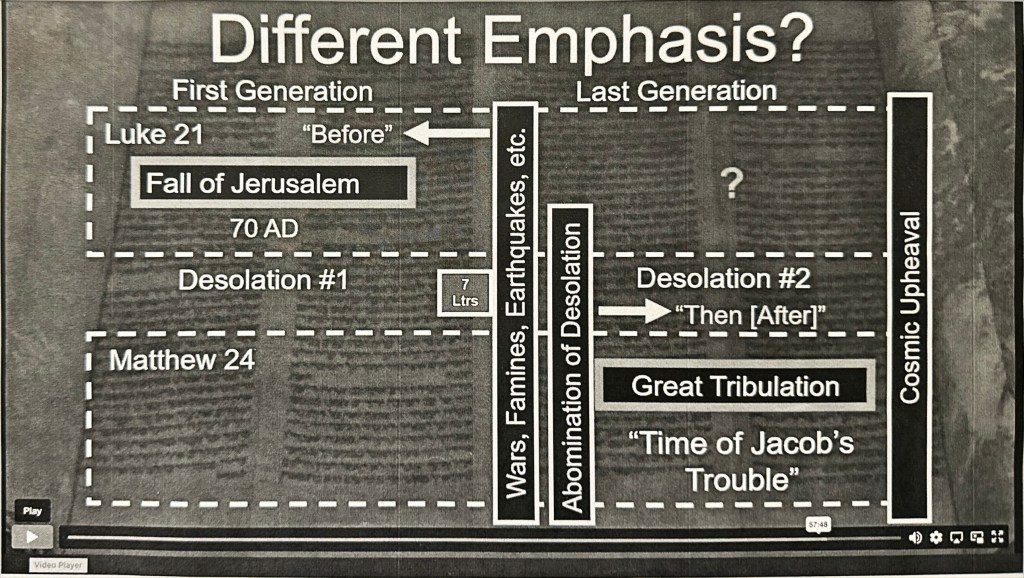
No, but the Holy Spirit communicated different messages (Matthew 24-25; Mark 13; Luke 21) by the emphasis and focus He gave the Gospel writers’ choice of words in their reporting. The difference can be as great as the Preterist insistence that all prophecy was practically fulfilled in the 70 AD Roman destruction of Jerusalem (Luke 21), and the opposing Futurist insistence that the Seventieth Week of Daniel (Daniel 9:24-27) is coming and soon to be fulfilled (Matthew 24).
Matthew’s Gospel was directed more to the Jewish mindset with the identification of Jesus as King, Messiah, and Savior of the Jews. Hence, Matthew points out the Abomination of Desolation (Daniel 9:27 cp. Matthew 24:15) and Luke does not. Written in 63-68 AD, Luke foretells the upcoming 70 AD destruction of Jerusalem, where Jesus warned Christians to flee “when ye shall see Jerusalem compassed with armies” (Luke 21:20 KJV). Christ made possible the escape from the Roman destruction of Jerusalem of all those who believed the Gospel of Luke’s warning. In similar fashion, Christ will make possible the future escape of all those who believe His warning about the prophetic “abomination of desolation” (Matthew 24:15), when it finally occurs.
The crucial flaw of the Preterist position, i.e., essentially all prophecy was fulfilled in the 70 AD destruction of Jerusalem, is the lack of the Abomination of Desolation fulfillment at a time future to Christ’s pronouncement on the Mount of Olives, i.e., “When ye therefore shall see the abomination of desolation” (Matthew 24:15), and certainly not an already occurred fulfillment, i.e., Antiochus Epiphanies (“God Manifest”) sacrificing swine flesh on the Jewish Temple altar between the OT and NT eras. “3 Let no man deceive you by any means: for that day shall not come, except there come a falling away first, and that man of sin [Antichrist] be revealed, the son of perdition; 4 Who opposeth and exalteth himself above all that is called God, or that is worshipped; so that he as God sitteth in the temple of God, shewing himself that he is God” (2Thessalonians 2:3-4).
Luke’s Gospel had more the Gentile readers in view, not mentioning the Abomination of Desolation (Daniel 9:27), yet, both Matthew and Luke mention a crisis with Jerusalem, causing any faithful inhabitants to flee: (1) 70 AD, “when ye shall see Jerusalem compassed with [Roman] armies,” then “flee” (Luke 21:20, 21), and (2) prophetic future, Tribulation Week, Seventieth Week of Daniel, “When ye therefore shall see the abomination of desolation, spoken of by Daniel,” then “flee” (Matthew 24:15, 16). Matthew, Mark, and Luke foresaw “nation shall rise against nation” (Matthew 24:7; Mark 13:8; Luke 21:10). All the Synoptic Gospels recorded the betrayal of friends and family by those who do not share your loyalty to Christ (Matthew 24:10; Mark 13:12; Luke 21:16). If this turmoil took place within Christ’s Twelve Apostles, should we be surprised it would take place prior to Roman’s destruction of Jerusalem in 70 AD, or that it would characterize a future time in the Tribulation Week shortly before the Second Coming of Jesus Christ?
The confusion of Biblical interpreters amounts to whether we take the obvious message of Christ’s Sermon on the Mount (Olivet Discourse) and find fulfillment solely in the 70 AD Roman Destruction of Jerusalem (Luke 21), or whether we can also discern the deeper implication of a future Abomination of Desolation (Matthew 24:15) and the Seventieth Week of Daniel (Daniel 9:24-27).
Failure to see the Futurist View of an upcoming Tribulation Week separates much of the Evangelical Church, where Israel practically has been replaced by the Church, and Israel has no future role in the Kingdom of God, but an asterisk or footnote to the future glory of the Church. Of note, this liberalization of OT prophecy is due to a distaste of taking God’s Word at face value, literally, and in my opinion, contributes to the overpowering antisemitism permeating secular society. The Church cannot restrain secular society from antisemitism because it does not view antisemitism as any worse than any other hatred. To be clear, Antisemitism is the focus of Satan’s hatred upon God’s chosen people. “Come, and let us cut them off from being a nation; that the name of Israel may be no more in remembrance” (Psalm 83:4). Remember, only “through their [Israel’s] fall salvation is come unto the Gentiles” (Romans 11:11), but it is “for to provoke them [Israel] to jealousy” (11:11) that Israel finally would be saved. “For I would not, brethren, that ye should be ignorant of this mystery, lest ye should be wise in your own conceits; that blindness in part is happened to Israel, until the fulness of the Gentiles be come in” (11:25). Luke’s Gospel instructs us, the times of the Gentiles is about to end. “And they shall fall by the edge of the sword, and shall be led away captive into all nations: and Jerusalem shall be trodden down of the Gentiles, until the times of the Gentiles be fulfilled” (Luke 21:24).
LORD, certainly this discussion is like so much noise that must be blocked out because of the more pressing matters of day to day survival. But, Spirit of God, use this understanding to remove the blinders from our eyes, which have held us in our respective theological traditions. May the day come again where there is “One Lord, One Faith, One Baptism” (Ephesians 4:6), but especially, “One God and Father of all, who is above all, and in you all” (4:7). Lord Jesus, return quickly. Amen and amen.
For a more developed discussion, see our article, Do You Believe There Will Be New Heavens and New Earth?
 We Need A Miracle
One thought on “Two Olivet Discourses?”
Comments are closed.